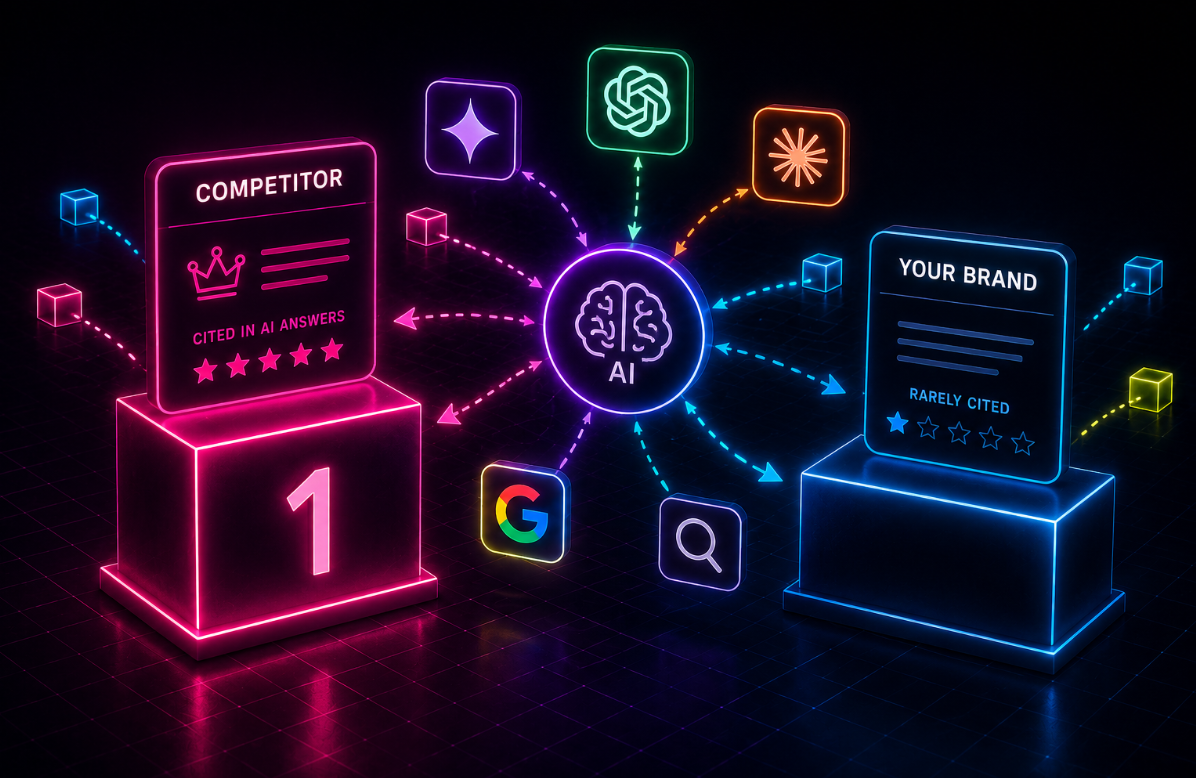
Why AI Citation Gaps Are Becoming a Major Visibility Problem
Many brands invest heavily in SEO, content marketing, and digital PR, yet still struggle to appear in AI-generated answers.
At the same time, competitors with similar products, authority levels, and website traffic seem to earn citations consistently across ChatGPT, Gemini, Claude, Perplexity, and Google AI Overviews.
This raises an important question:
Why does AI mention your competitors more often than your brand?
The answer usually isn't a single ranking factor. Instead, it is a combination of authority signals, entity recognition, content coverage, and brand presence across the web.
Understanding these gaps is becoming essential for modern GEO and AI visibility strategies.
What Is a Citation Gap?
A citation gap exists when competing brands are referenced by AI systems more frequently than your organization for the same topics, products, or services.
For example:
- Your competitor appears in AI-generated recommendations.
- Their content is referenced more often.
- Their brand is associated with key industry topics.
- Your company rarely appears despite having similar offerings.
This visibility gap can directly impact awareness, trust, and customer acquisition.
The Five Most Common Reasons Competitors Get More Citations
1. Stronger Entity Recognition
AI systems increasingly rely on entities rather than keywords.
When a model clearly understands who a company is and what topics it specializes in, the brand becomes easier to recommend.
Strong entity signals often include:
- Consistent brand naming
- Author profiles
- Industry mentions
- Structured data
- Company references across trusted websites
Many brands focus on content while neglecting entity development.
2. Broader Topical Authority
Competitors that consistently publish around a topic cluster are more likely to be associated with that subject.
For example, if a company publishes content about:
- GEO
- AI Visibility
- AI Citations
- Brand Authority
- LLM Optimization
AI systems may view them as a stronger authority than a competitor publishing only occasional content.
Topic ownership often matters more than individual articles.
3. Better Off-Site Signals
AI models evaluate information beyond your website.
External signals can include:
- Media coverage
- Industry publications
- Research reports
- Interviews
- Conference appearances
- Expert contributions
These references help reinforce trust and authority.
Brands with stronger off-site footprints often receive more citations.
4. Higher Brand Consistency
Inconsistent messaging creates confusion for both users and AI systems.
Common problems include:
- Different company descriptions across platforms
- Conflicting positioning statements
- Inconsistent terminology
- Multiple versions of service descriptions
The more consistent a brand appears across the web, the easier it becomes for AI systems to understand and recommend it.
5. Citation Momentum
AI visibility often compounds over time.
Brands that receive citations today are more likely to receive citations tomorrow.
As more sources reference a company, stronger authority signals are created across the ecosystem.
This creates a positive feedback loop that can be difficult for competitors to overcome.
How to Identify Your Citation Gap
The first step is understanding where competitors outperform you.
Organizations should monitor:
- Citation Share
- Mention Frequency
- Competitor Visibility
- Recommendation Rates
- Sentiment Trends
- Cross-LLM Performance
Using an AI Brand Visibility Platform, teams can identify which competitors dominate AI-generated answers and uncover visibility gaps that traditional SEO tools cannot detect.
Why Traditional SEO Data Is No Longer Enough
Traditional SEO tools measure:
- Rankings
- Keywords
- Backlinks
- Organic Traffic
These metrics remain valuable.
However, they do not explain why a competitor appears inside an AI-generated answer while your brand does not.
This is where AI visibility measurement becomes critical.
Organizations that only track search rankings may miss significant shifts in customer discovery behavior.
Closing the Gap: A Practical GEO Framework
Improving citation performance typically requires work across four areas:
Strengthen Entity Signals
Make it easier for AI systems to understand your brand and expertise.
Expand Topic Coverage
Build comprehensive content clusters around strategic themes.
Increase Brand Mentions
Develop authority through PR, partnerships, interviews, and industry contributions.
Measure Continuously
Track visibility changes across ChatGPT, Gemini, Claude, and Perplexity to identify opportunities and measure progress.
For organizations building long-term AI visibility strategies, our guide on The AI Citation Playbook provides a deeper framework for increasing citations across LLMs.
Final Thoughts
Most citation gaps are not caused by a lack of content.
They are caused by a lack of authority signals, entity recognition, topical ownership, and visibility monitoring.
As AI-powered discovery becomes more influential, brands that understand why competitors earn citations will be better positioned to improve their own presence across AI-generated answers.
The organizations that win in GEO will not necessarily be the ones that publish the most content—they will be the ones that build the strongest signals of trust, relevance, and authority.
Frequently AskedQuestions
What is a citation gap?+
A citation gap occurs when competitors are mentioned by AI systems more frequently than your brand for similar topics or queries.
Why do competitors appear more often in AI answers?+
They often have stronger entity signals, broader topical authority, and more trusted mentions across the web.
Can traditional SEO tools identify citation gaps?+
No. Most SEO tools track rankings and traffic but do not measure AI citations or LLM visibility.
How can brands improve AI citation performance?+
Focus on entity optimization, topical authority, brand mentions, and ongoing AI visibility monitoring.
Written by
Eyal Fadlon
AI Visibility Expert