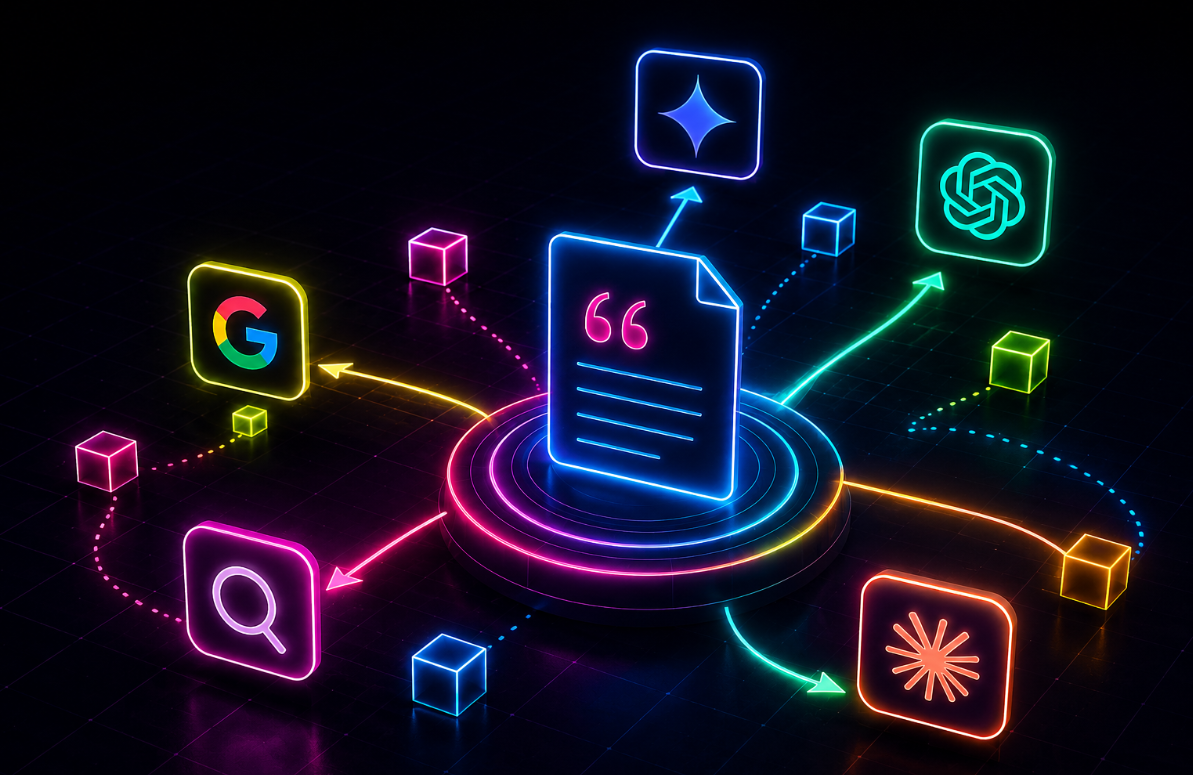
Why AI Citations Matter More Than Rankings
For years, digital marketers focused on rankings, traffic, backlinks, and keyword positions. While those signals still matter, the rise of AI-powered search experiences has introduced a new metric that is rapidly becoming just as important: citations.
When users ask questions in ChatGPT, Gemini, Claude, Perplexity, or Google AI Overviews, these systems increasingly provide answers that reference specific sources, brands, products, and websites. Some brands appear repeatedly, while others are rarely mentioned.
The difference is rarely accidental.
Understanding how Large Language Models (LLMs) decide which brands to mention is becoming a critical part of modern AI visibility strategies.
What Is an AI Citation?
An AI citation occurs when an AI system references a source while generating an answer.
Examples include:
- A website linked in a Perplexity response
- A brand mentioned in a ChatGPT recommendation
- A source referenced in Google AI Overviews
- An article cited within Gemini-generated answers
Unlike traditional search rankings, citations are not limited to the top result on a search engine results page. Multiple brands can be included within a single answer, creating new opportunities for visibility.
In many industries, users may never click a traditional search result if the AI answer already provides sufficient information.
As a result, earning citations is increasingly becoming a primary visibility objective.
Why Do Some Brands Get Cited More Often?
Many marketers assume that domain authority or backlinks alone determine AI visibility.
While these factors still contribute, AI systems evaluate a broader set of signals.
Authority
Brands that consistently publish high-quality content are more likely to be referenced.
Consistency
Information that appears repeatedly across multiple trusted sources is often viewed as more reliable.
Entity Recognition
AI systems are increasingly focused on entities rather than keywords.
A brand that is clearly recognized as an entity within a topic area has a stronger chance of being cited.
Contextual Relevance
Even highly authoritative websites may not be cited if they are not directly relevant to the user's question.
Brand Mentions
References to your company across the web can reinforce topical authority and trust.
This is one reason why many organizations are investing more heavily in digital PR and authority-building initiatives.
The Five Layers of Citation Optimization
Successful AI visibility programs usually focus on five distinct layers.
1. Content Authority
The foundation remains strong content.
Brands should create comprehensive resources that:
- Answer real user questions
- Demonstrate expertise
- Cover topics in depth
- Remain updated over time
Superficial content is increasingly less likely to be referenced by modern AI systems.
2. Entity Development
AI systems need to understand who you are.
This requires building a recognizable entity footprint through:
- Consistent branding
- Author profiles
- Company information
- Industry references
- Structured data
The stronger your entity signals, the easier it becomes for AI systems to associate your brand with specific topics.
3. Off-Site Authority
Many citation opportunities are influenced by signals beyond your website.
Important sources include:
- Industry publications
- Research reports
- Interviews
- Conference participation
- Digital PR coverage
The goal is to create multiple trustworthy references that reinforce your expertise.
4. Topic Ownership
Brands that dominate a topic cluster tend to receive more citations.
Instead of publishing isolated articles, organizations should build content ecosystems around strategic themes.
For example, a company focused on AI visibility may publish content covering:
- GEO
- AI search optimization
- AI citations
- LLM visibility
- AI brand authority
Over time, this creates stronger topical associations.
5. Citation Monitoring
Many organizations do not know whether they are being cited at all.
Without measurement, optimization becomes impossible.
Modern teams increasingly use dedicated visibility platforms to monitor:
- Citation frequency
- Competitor mentions
- Share of voice
- Brand sentiment
- Cross-LLM performance
Solutions such as AI Brand Visibility Platforms help organizations understand how frequently they appear across major AI systems, identify visibility gaps, benchmark competitors, and track citation performance across multiple LLMs.
Common Citation Mistakes
Many brands unintentionally reduce their chances of being cited.
Publishing Generic Content
Content that simply repeats information already available elsewhere rarely becomes a preferred source.
Ignoring Brand Authority
Strong content alone is often insufficient if AI systems cannot identify the brand behind it.
Focusing Only on Rankings
Traditional SEO metrics remain valuable, but AI visibility requires additional measurement frameworks.
Weak Topic Coverage
Publishing one article on a topic is rarely enough to establish authority.
Lack of Monitoring
Without visibility data, organizations cannot identify opportunities for improvement.
How to Measure Citation Success
Organizations should track several key indicators:
- Citation Share
- Mention Frequency
- Competitor Citation Gap
- Brand Recommendation Rate
- Sentiment Distribution
- Cross-LLM Visibility
Together, these metrics provide a clearer picture of how AI systems perceive and reference a brand.
Organizations looking to establish a structured measurement framework can explore our guide on measuring AI visibility ROI, which covers the metrics that matter most across modern AI platforms.
The Future of AI Citations
The importance of citations is likely to increase as AI search continues to evolve.
Users are becoming more comfortable receiving direct answers rather than browsing multiple websites.
This means brands will increasingly compete not only for rankings, but also for inclusion within AI-generated responses.
Organizations that build authority, strengthen entity recognition, and monitor citation performance today will be better positioned as AI becomes a primary discovery channel.
Understanding how trust is formed within AI-generated answers is becoming increasingly important. Our article on how AI systems build brand trust explores the signals that influence recommendations and citations.
Final Thoughts
The future of visibility is not simply about ranking first.
It is about becoming a trusted source that AI systems choose to reference.
Brands that focus on authority, entity development, topical ownership, and citation monitoring will be significantly more likely to earn mentions across ChatGPT, Gemini, Claude, Perplexity, and future AI search platforms.
As AI-generated answers become a dominant discovery mechanism, citations may become one of the most valuable visibility signals a brand can earn.
Frequently AskedQuestions
What is an AI citation?+
An AI citation occurs when an AI platform such as ChatGPT, Gemini, Claude, Perplexity, or Google AI Overviews references a website, brand, article, or source while generating an answer. Citations help users understand where information comes from and play an increasingly important role in AI visibility.
Why are some brands cited more often than others in AI answers?+
AI systems tend to cite brands that demonstrate strong authority, clear entity recognition, topical expertise, and consistent mentions across trusted sources. Brands with a well-established digital presence are generally more likely to appear in AI-generated responses.
How can businesses improve their AI citation share?+
Businesses can improve citation share by creating authoritative content, building strong entity signals, earning mentions from reputable websites, strengthening topical authority, and continuously monitoring their visibility across AI platforms.
Are AI citations more important than traditional search rankings?+
Traditional rankings remain valuable, but AI citations are becoming increasingly important as users rely more on AI-generated answers. In many cases, being cited within an AI response can drive brand awareness and influence purchasing decisions even when users never visit a search engine results page.
Written by
Eyal Fadlon
CGO @42A